


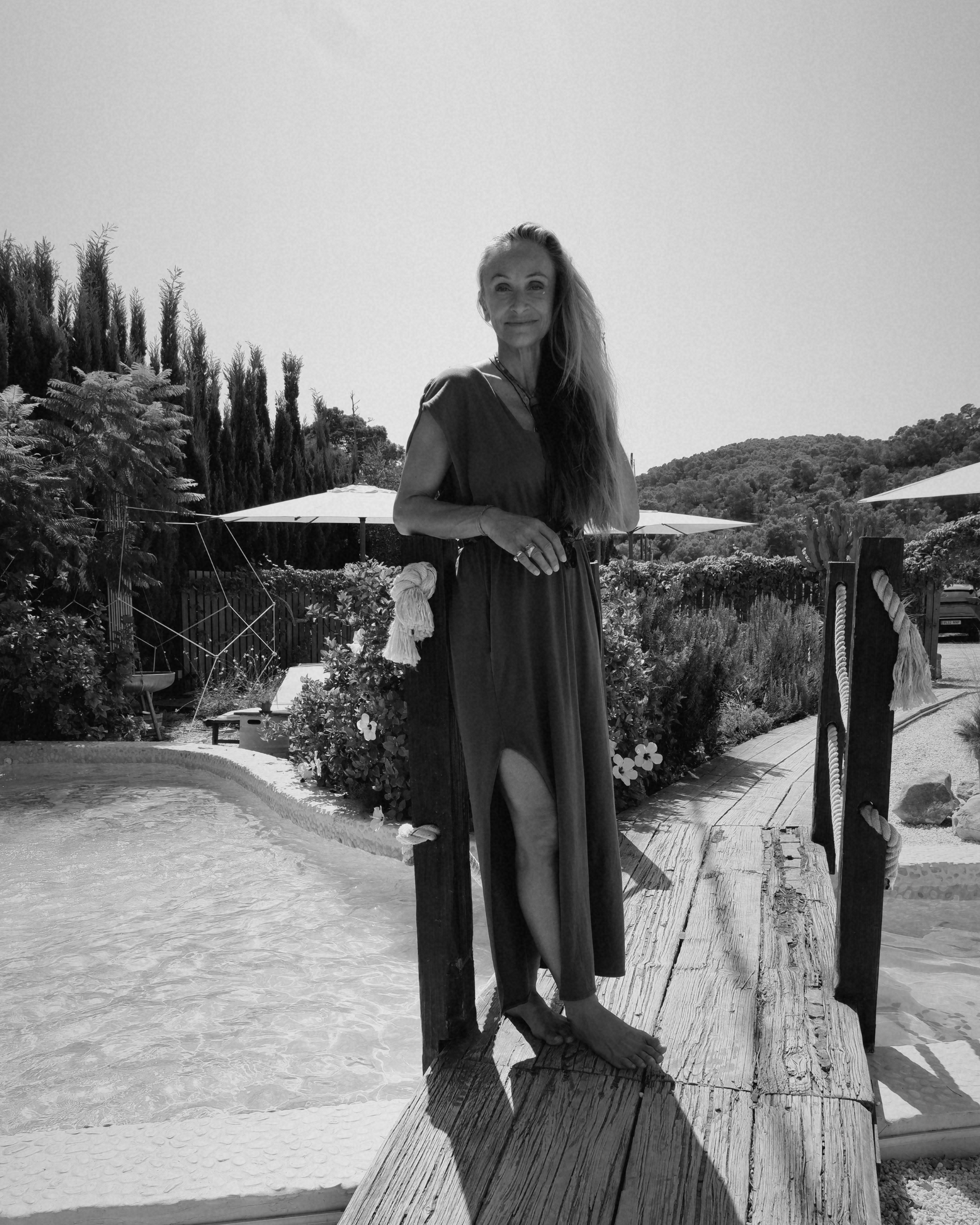
ELISABETTA CARACCIA
MOTHER
FOUNDER, LA CURANDERA
FOUNDER, RAY OF LIGHT AWARDS
Grew up in: Novi Ligure, Italy
Living in Ibiza since: 2008
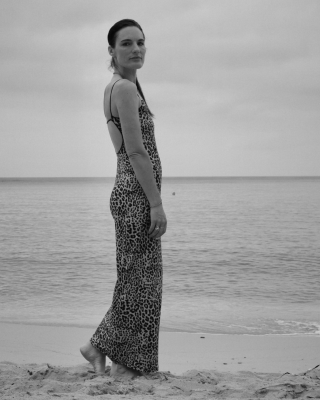
Elisabetta Caraccia first came to Ibiza at 17, after years of listening to the stories her older siblings brought home from the island. More than three decades later, it is where she has raised her children, built a home and found a community that would hold her through unimaginable loss.
Her life here has moved through many versions of Ibiza, from long days and nights on the dance floor to motherhood, women’s circles, La Curandera and the Ray of Light Awards, but the freedom she found on that first visit remains at the heart of what the island means to her.
Elisabetta grew up in Novi Ligure, a small town between Milan and Genova, where her father was from and her Roman mother moved after they married. Although industrial in parts, her childhood was lived largely in nature, surrounded by trees and animals. At 18 she would leave for Rome to attend university, but a year earlier another place had already entered her life. Her two brothers and sister had been coming to Ibiza for some time, returning to Italy with extraordinary stories and cassette tapes filled with music.
“I was really craving the moment when I could discover this magic land as well.”
When a group of friends invited her to join them on a 24-hour journey to the island, she went. “That was my Ibiza christening.” For the next decade, Ibiza was largely about friends, electronic music and dancing for as long as possible, with the occasional trip to the beach in between. Elisabetta was already immersed in Italy’s electronic music scene, which she remembers as extraordinarily creative at the time, but Ibiza offered something different. On its dance floors she found people from different countries, cultures, ages and parts of society coming together and remaining friends long after the music stopped. Beyond the clubs, that same freedom spilled into the streets of Ibiza Town. She remembers emerging in elaborate costumes alongside people who hadn’t slept for days, while older Ibicencos sat on benches watching them pass.
“Old Ibicencos would just be sitting there with a sort of detached curiosity but always tolerant and welcoming. They had gone through the hippie phase and knew that you are not necessarily dangerous just because you look different and eccentric. Everyone was happy to express themselves beyond any mask. The freedom that was here in those years was what felt really amazing.”
Ibiza remained somewhere she returned to until becoming a mother allowed her to discover an entirely different island. When her eldest son was six months old, Elisabetta brought him with her for the first time. Her friends continued going out while she stayed with her baby, breastfeeding, spending her days on the beach and experiencing what she calls “the other kind of Ibiza life”. For the first time, she began to imagine staying. That same year she rented a house in Es Cavallet for the winter, initially as a pause while deciding where life would take them next. She never really left.
Over the years, Elisabetta has found herself at home within almost every version of the island.
“For me, Ibiza was a place full of sunshine, laughter and unity. I look back at those days and nights spent on the dance floor and I realise that it all was like a ceremony, it was the way we found to come together as one and celebrate life.”
The contrasts that might seem incompatible elsewhere feel entirely natural to her here. Sweat lodges and yoga exist alongside superyachts and glamour, ancient traditions beside international influences, and each offers an opportunity to work out where you belong.
“Ibiza really helps people drop their masks and get into their raw self.”
For Elisabetta, the energy of the island is difficult to put into words. She believes it is something that has to be experienced rather than explained, and that those who feel it will understand why so many people arrive here and find themselves staying.
“If it resonates with you, it means that you were meant to land on this island. You’d better just be open and ready for all the gifts and challenges that Ibiza can give you.”
That openness has changed far more than where she lives. Ibiza introduced her to ceremonies and traditions she had never encountered before and helped her become more attuned to her feminine side. It was here that she joined the first women’s circle of her life, originally held by her friend Valerie. After Valerie passed away, Elisabetta inherited the circle and has continued holding space for it every Wednesday since 2014.
“It has been such a safe place for me and all of us, my beautiful sisters together. It’s beautiful to feel how much love we can have for one another, even when we barely know each other.” She feels a connection between those gatherings and Tanit, whose presence has long represented feminine energy on the island. “I think Tanit rejoices in this. She’s the one that opened up this space and energy for us to gather in these ways.”
Her life today is filled with things she never imagined for herself. For years, much of her time was devoted to organising life for her children, filling their childhood with the activities, experiences and freedom the island offered. Elisabetta believes creating that kind of childhood requires active parenting too, particularly now, when it can be so easy for children to disappear behind screens.
“You have to be very active as a parent.”
In 2021 she took on La Curandera, the boutique hostel in Salinas. Then, after the sudden passing of her partner and the father of her children, actor Ray Stevenson, in 2023, another unexpected path appeared. Friends of Ray proposed the idea that would become the Ray of Light Awards, a film festival and conscious cultural movement created in his memory, which Elisabetta has since taken forward. “The island shaped it in every way.” She had never imagined any of these things would form part of her life.
“I would never have thought I was going to have a boutique hostel, and I would never have thought I was going to be curating a film festival. I actually didn’t know I was going to raise a family in Ibiza. But there we go. This island brought all of this to me.”
Losing Ray also changed Elisabetta’s relationship with Ibiza in a much deeper way. She speaks openly about how differently she believes grief would have felt had she been living somewhere else, and of the island and the people around her holding both her and her children through it.
“If I had to go through the passing of my husband in another place, it would definitely have been a completely different story. Ibiza helped me and my children in an extraordinary way.”
She remains deeply thankful for the community that gathered around her family during that time.
The experience also deepened ideas about life and death that Ibiza had been opening her towards for years. “The wisdom of this island helped me realise that you can still feel like you’re next to each other even if you’re not both on this planet, and that life goes so much beyond this empirical experience.” Her rituals are now part of the rhythm of everyday life: temazcals at the full and new moon, swimming in the sea throughout winter, often almost daily, and making time to cuddle her children whenever she can. Salinas, Es Cavallet and Cap des Falcó form the familiar landscape around home, alongside the sunsets and sunrises she still makes time for when she can.
Motherhood has been central to Elisabetta’s life on the island. When she and Ray were deciding where to raise their family, his work as an actor meant they could have chosen almost anywhere. London and Los Angeles were the obvious possibilities, but neither felt right. Elisabetta wanted her children to grow up as she had, surrounded by nature, without returning to the limitations she had felt in a small provincial town. Ibiza gave them both.
“It’s cosmopolitan in the best possible way because it attracts the best and craziest people, the black sheep from all over the world who find their home over here. So many free thinkers and creative and heart-centred people!”
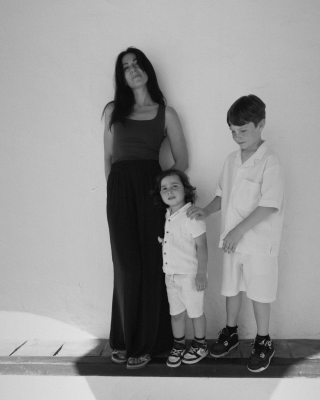
Her children were born in different places: Sebastiano in Montreal, Leonardo in Rome and Lodovico at home in Salinas. They have grown up on the island surrounded by trees, birds, sea and people from all over the world. They attend the French school, live close to a nudist beach and have friends from many different cultures and backgrounds. “They are just ready for life.” For Elisabetta, the privilege lies in that combination. They can spend their childhood immersed in nature while absorbing languages, beliefs, customs and ways of living that extend far beyond the shores of Ibiza.
“It’s that perfect balance between growing up in nature and growing up in a cosmopolitan environment where you can expand your ability to look at the world, accept differences, speak many languages and be exposed to so many different realities.”
There are countless memories of that childhood already. Her older boys rolling down the salt mountain at Salinas when children could still play there, or covering themselves in Posidonia, jumping into piles of it and becoming “seaweed monsters”. Others belong entirely to family life at home. Her third child was born in the house beside their bed, and that first night the newborn slept there alongside his siblings, Elisabetta and Ray. By morning, Ray had surrendered his place completely and was asleep on a sheepskin on the floor.
“He realised that with three children there was no more room for him in the bed for all of us to be comfortable. The next day he went to Ibiza Truc and bought a massive bed, like a double king-size, which is the bed that we still have.”
As her children move towards adulthood, Elisabetta hopes the island has given them something less tangible too. She wants them to carry the knowledge that people from entirely different places and backgrounds can share a home and create something together.
“Ibiza shows you that it’s possible to cohabit on one island being from all over the world and from very different backgrounds, and turn that into something celebratory, creative and functioning.”
Just as importantly, she hopes their relationship with the natural world has become instinctive.
“It’s good to become an adult knowing that connection with nature and with the sea is imprinted into your being because that was part of your upbringing.”
If Ibiza were their teacher, Elisabetta believes the lessons would be gratitude, tolerance and the ability to celebrate difference. “Gratitude, tolerance and being proactive.” For her children, she hopes that freedom extends to knowing there is space here for whoever they grow up to become.
“I think it’s the inner freedom to know that they can express themselves. They will always find somebody who supports them and someone to share their passion with. They will always find some inspiration somewhere on this island and know that they can be who they are and feel like what they bring is needed in the world.”
The sea itself has become part of that education. She speaks about the infinite horizon and the unexpected sense of safety she has found in being surrounded by water.
“The sea is amazing as a companion.”
“I never thought I would love being on an island so much.”
More than three decades after that first 24-hour journey, freedom remains the thing Elisabetta most wants Ibiza to protect. “The freedom to gather as we wish.” It is this freedom that she believes has allowed so many people to find one another here, to live differently and to create community. She hopes Ibiza will continue attracting the unusual mix of people who have long made the island what it is. Her hope for its physical future goes further than preservation. She would like to see parts of Ibiza restored, the Santa Eulària river flowing again, fields cultivated and nature allowed to flourish as development slows.
“I hope there will be a moment in which we really stop growing and building, and we’re just going to start seeing nature flourishing more and more. The fields becoming cultivated, maybe more sustainable houses, more yurts and fewer condos.”
For Elisabetta, Ibiza has never offered a straight path. It brought her here as a teenager looking for music and freedom, became the place where she chose to raise her children and later held her family through loss. What she hopes remains is the possibility that brought her here in the first place: that people can arrive from very different corners of the world, find one another and be given enough freedom to become themselves fully.
more reflections
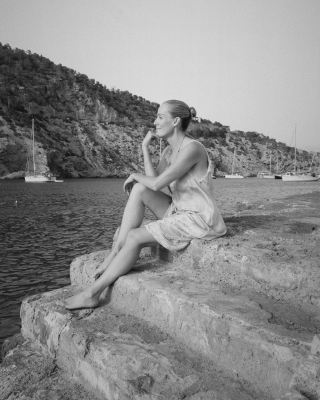
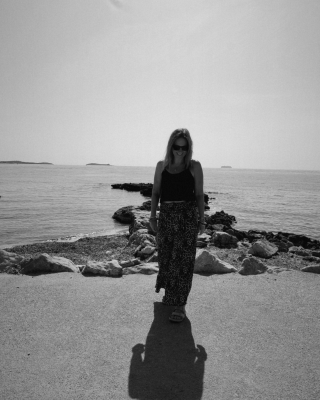
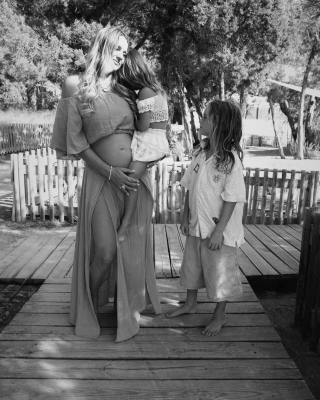
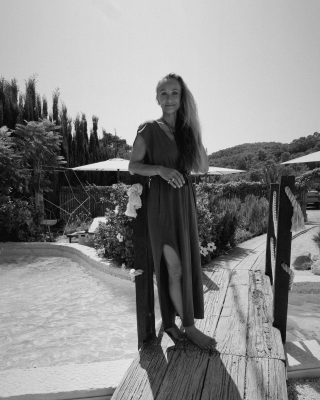
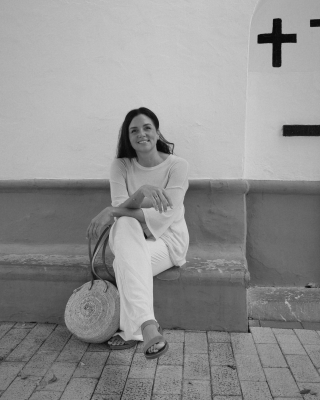
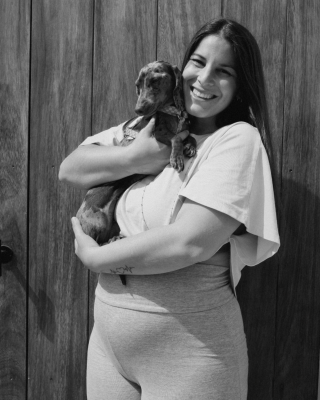
Elisabetta Caraccia
From Ibiza’s dance floors to motherhood, women’s circles and the Ray of Light Awards, Elisabetta Caraccia reflects on more than three decades of island life, raising her children surrounded by nature and finding strength in the community that held her family through loss.